From scattered experiments to a capability the organisation owns
How a large, established organisation moved from scattered AI experiments to a GenAI Centre of Excellence it runs itself.
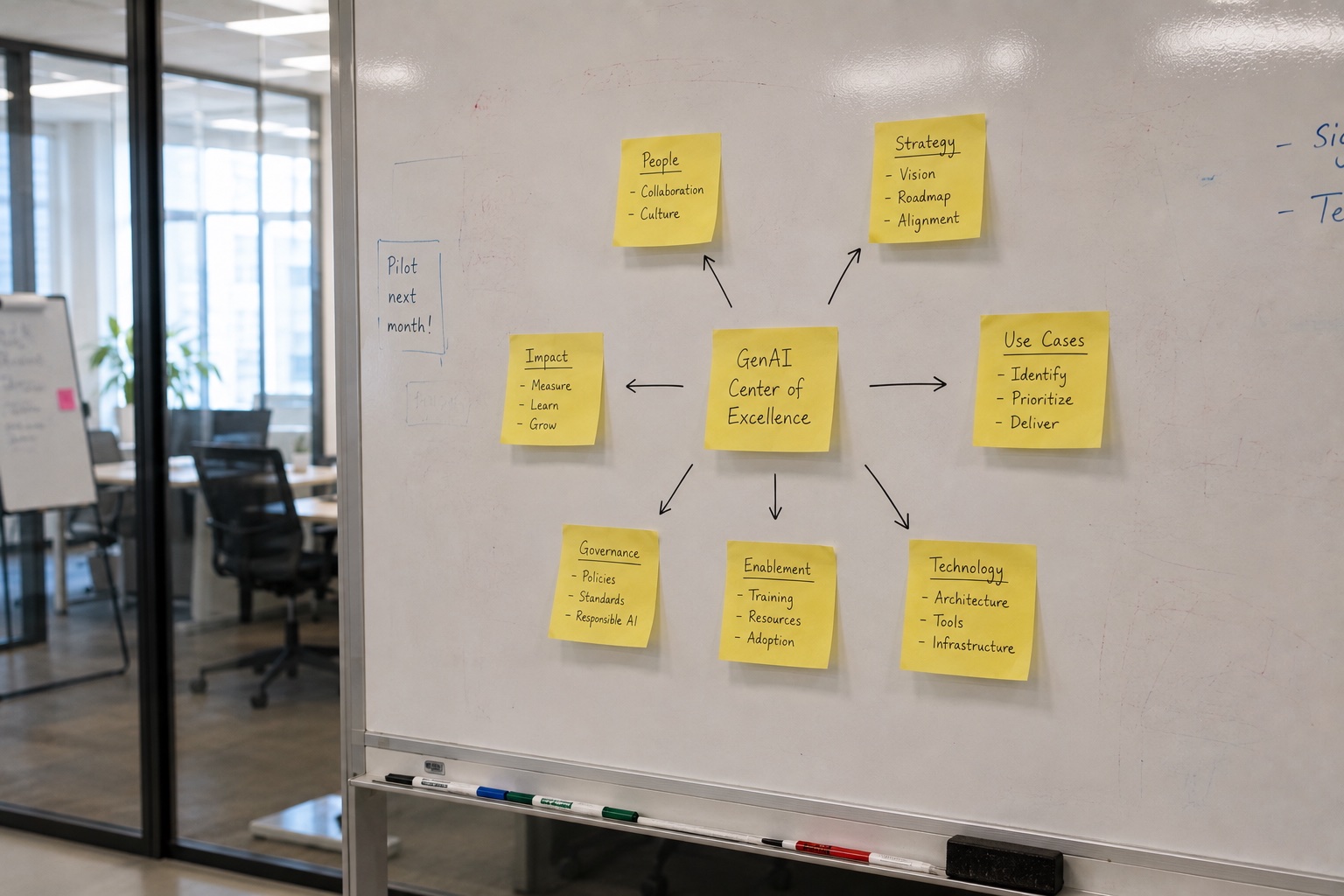
How a large, established organisation moved from scattered AI experiments to a GenAI Centre of Excellence it runs itself.
AI experiments existed before the CoE, scattered across the organisation. IT teams built independently, knowledge stayed inside departments, and no one had a shared view of what was underway. Little of it aligned with strategy. Almost nothing was reused.
Inside the organisation, AI had a reputation: technically complex, organisationally risky. Outside, GenAI kept accelerating. Leadership saw potential, technology teams saw solutions, business teams saw complexity — nobody shared a picture of what to build, why it mattered, or how it would be adopted. Closing that gap needed structure, not more pilots.
Together we designed and launched a GenAI Centre of Excellence with a clear enterprise mandate: the one place where GenAI moves from experiment to capability. The work spans the breadth of the operation, and each business unit came with its own value case.
To turn that demand into results, the CoE was given three jobs:
Four pillars. Each is as much about people and trust as about technology.
The innovation lab, the low-code team, enterprise systems, architecture, security, business units and delivery all worked on AI, each in its own room. The community put them in one; six business units now work on AI initiatives together. Representatives from the major enterprise platform teams, the CISO and the architecture board join the sessions to shape the standards the organisation scales on.
One of its instruments is the “Doctor House” review: a team presents a use case, and cross-functional colleagues argue out which technology fits and which patterns have already proven themselves. Nothing kills duplication faster than showing your work to people who have done it before.
The community reaches upward too. Every few months the senior leadership team and members of the board join an off-site: hands-on sessions with the work, not slide readouts. Seeing the initiatives up close aligned business and IT on one AI strategy. We brought in cases from other organisations doing the same job and, where it helped, connected people to those teams so they could learn first hand.
I designed the forums and rituals that turned separate teams into one conversation, then made sure they did not depend on me. The community holds because the organisation’s own AI architect and innovation lead carry it forward, session after session.
A structured intake that answers the questions that matter early: who the users are and what they struggle with; what the business process looks like, mapped visually with the spots where AI could help; whether AI solves the real problem; whether the data is ready; what it will cost and what it should return; where it sits under the EU AI Act; which tool fits — and whether to build it at all. That last question gets asked seriously. Requests are then ranked by value, complexity and reusability. For the first time, the organisation had one shared picture of AI demand, and a way to say no.
I sat between business and delivery: shaping each request around the real process, building the value case with the people who would own it, and drawing the portfolio so every team could see how their work fed the same picture. Momentum came from that visibility. Teams stopped waiting for permission and started building on each other.
A GenAI reference architecture, approved by the architecture board, with reusable capabilities for retrieval, safety, logging, agent orchestration and human-in-the-loop. Around it: decision trees for solution design — low-code, no-code or custom — and a maintained catalogue of approved AI services and patterns. Security designed in from the start, so every new initiative begins on validated ground instead of a blank page.
When multi-agent orchestration came up, we took the choice of pattern to the community as an open question; the people who would build with it argued it out, so it left the room as a shared standard. Teams now contribute agents as reusable parts and the CoE stitches them into services: a retrieval agent built for one business unit becomes a building block for the next.
Turning what proved itself in pilots into things the organisation owns — patterns, standards, and the governance to move consistently — working alongside the AI architect so the platform grew out of real delivery.
The biggest risk in enterprise AI is not the technology. It is people — not trusting it, over-relying on it, or rejecting it outright. So end users and business stakeholders shape the requirements from day one, in shaping workshops where they map the pain points and the process: where AI would improve the outcome, where an agent could take over a task, and where a human has to stay in the loop. A solution the workforce has not approved never reaches practice.
The people who co-create the pilots become the first adopters, and the most honest critics. Their feedback drives iteration until the service delivers what the demo promised.
I co-created the proofs of concept and pilots with end users and the delivery team, built to produce evidence under real operational conditions. Adoption was planned in the first session, not at launch.
The early months were mostly friction, and the friction showed us where the real work was.
Approvals came first. Enterprise architects and the CISO were asked to sign off on technology that was new to them too — a reasonable position, and a slow one. GenAI doesn’t wait for annual governance cycles, so the same conversation needed a different shape and pace for each reviewer: evidence for one, patterns for another, a working pilot for a third. What worked was bringing them inside — co-developing the security patterns and the reference architecture with the people who would otherwise review them from outside.
Incentives came second. Teams were measured on their own delivery success, not on shared contribution, so mixing low-code and pro-code teams on one initiative stalled at first; each had reasons to keep the work in their own stack. Making the work visible changed that faster than any mandate could have. Once teams saw how their piece fed a shared outcome, contribution became something to show.
Most blockers are teams that cannot see each other’s work — or each other’s incentives.
A customer-facing assistant is live, built on the reference architecture, answering from the organisation’s own knowledge. Its scope is widening to new services and to the customer-service teams themselves, so they answer faster and with more precision.
A series of internal agents for HR follows. They act as well as answer: a leave request or a sickness notification is done inside the conversation, at any hour, without the form and the inbox it used to travel through.
Every initiative carries a value case. The agent that helps customer-service representatives write and respond to requests cut effort per case in half, across well over a hundred thousand requests a year. The value is more than minutes. Representatives get through peak periods — holidays, the start of a school year — without the backlog that used to follow, customers get answers faster, and the freed capacity goes into the conversations that need a human. None of it would run without the delivery team, who grew from supporting proofs of concept into the people who carry an initiative through to industrial build.
Designers have always said: never go to a meeting without a prototype. That is finally practical. In design sprints, business owners build working prototypes of their own vision — facilitated by designers, with the subject matter experts in the room. The prototype appears in front of everyone and gets challenged on the spot: do we have the right data, the right patterns? What does it mean for the CISO? Will end users understand the workflow?
It compresses weeks of requirements documents into an afternoon of honest argument, and the people who built the prototype leave owning the idea. Together with the intake and the shaping workshops, it is now the organisation’s default way to decide what to build.
Because the business logic now lives in the prompts, business and IT have to maintain it together, and that closeness is the part of the work that will outlast the CoE. The next phase is multi-agent systems across business units, a wider reusable platform, and governance that holds under load.
The CoE worked because it was designed to make itself unnecessary. If you have AI experiments in every department and a shared picture in none, that is the conversation I want.